
This is an old revision of the document!
Table of Contents
History and versions of QBerr
Initial steps of ellipsometry application development took place in the Department of Condensed Matter Physics, at the Faculty of Science, Masaryk University, Brno, Czechia. The department has a long history of ellipsometric research led by Josef Humlicek. The author of QBerr, Premysl Marsik, started his PhD studies at 2004 under the supervision of J. Humlicek and started building his first ellipsometer, including a data acquisition software.
At the time, the lab used a data processing program written by J. Humlicek called AB2PD, which stands for Alpha Beta to Psi Delta. This program takes raw rotating-analyzer ellipsometry data in .sig or .big format, extracts modulation parameters alpha beta, and calculates the ellipsometric Psi and Delta spectrum. It includes a calibration algorithm for corrections of offsets between nominal and actual azimuths of polarizer and analyzer. Data are saved in a file format .EPD (Ellipsometry Psi Delta).
Another program by J. Humlicek, called LOOKDATA, served as a viewer for the raw .sig and .big files. Both of these legacy programs were working on command line without graphical interface.
In 2005, P. Marsik wrote programs LookData2 and mab2pd. The LookData2 provided a GUI, and enriched the functionality of the LOOKDATA. The multi-ab2pd was a GUI based RAE calibration software, which added support for multiple RAE files taken at various polarizer azimuths. In 2006, P. Marsik built a rotating compensator ellipsometer together with a data processing and calibration software CalibRCE, and later in 2007 software for analysis of optical properties of thin films, called MFF - Multi Film Fit.
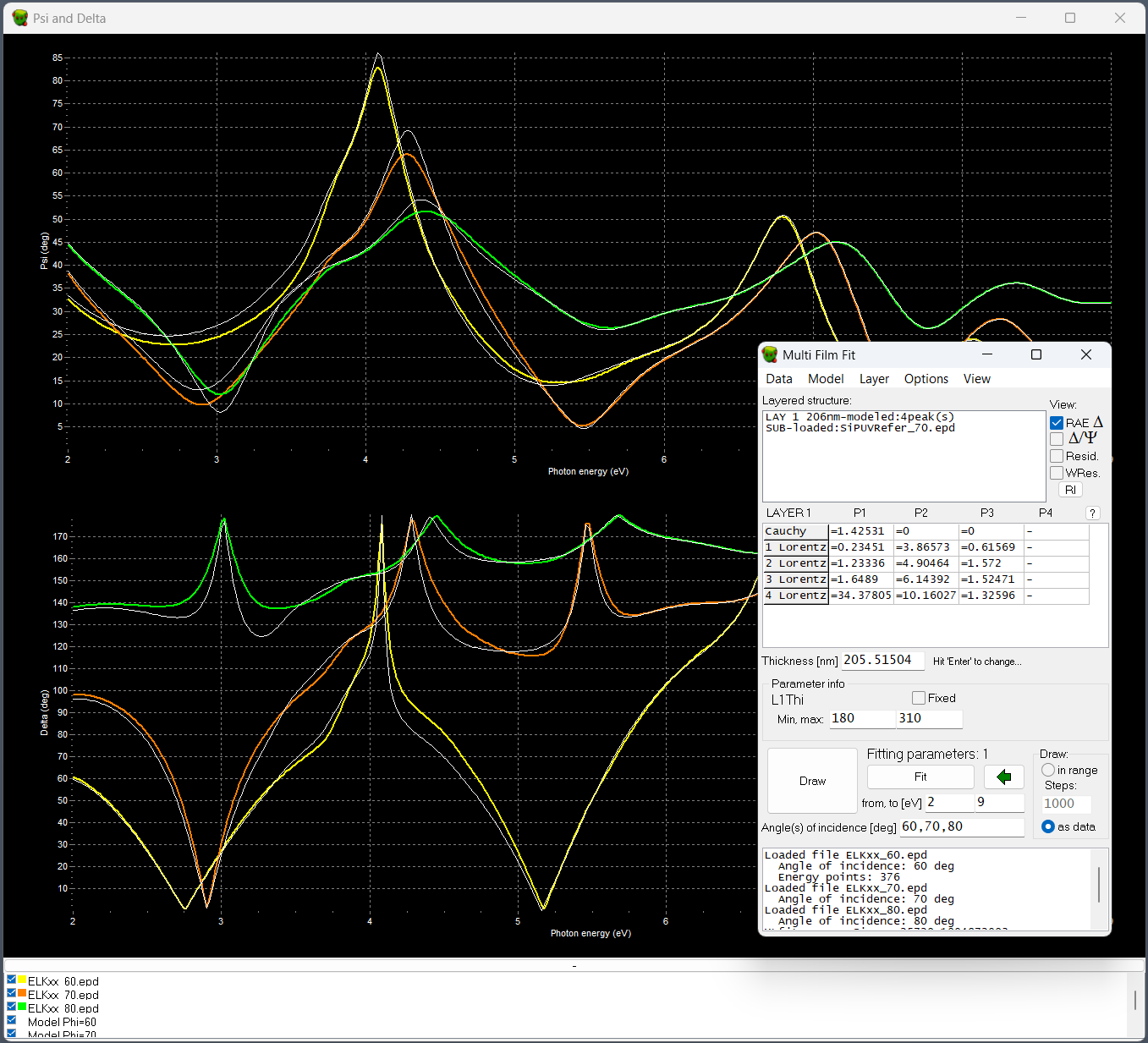
Somewhat retroactively, we loosely attribute these programs to the first generation of QBerr.
QBerr 1
The source code for programs in this generation is written in Pascal with GUI developed in Delphi framework.
In 2009, P. Marsik moved to the Deparment of Physics, University of Fribourg, and started building a time-domain THz ellipsometer, while also working with FTIR based infrared ellipsometers. The TD-THz ellipsometer was controlled with software called THzElli, which also had to produce compatible data files. This led to further software development and modifications of the libraries for the needs of the ellipsometry lab in Fribourg, together with data format standardization.
Many versions of mab2pd and LookData2 were deployed in the lab between 2010 and 2019, and some versions were also used on synchrotron-based IR ellipsometers at ANKA, Karlsruhe in Germany, and at NSLS, Brookhaven National Lab in the United States. LookData2 is still in use in 2026, with most recent update is version 2.1.4.0 from 2024 modified for data format produced by a new ellipsometer at NSLS-2 in Brookhaven.
About 2012, a new file format was introduced, .epdx, which is a XML wrapper for metadata and CSV data conforming with the original .epd format.
Between 2010 and 2015, new program for analyzing and modeling ellipsometry data was developed, called Berreman, in honour of Dwight W. Berreman. It implemented his 4×4 matrix method for calculation of wave propagation in generally anisotropic and optically active media. Curiously, the solution to the 4×4 problem was done analytically using the Cardano and Ferrari formulas. The Berreman software included new DataMan operating with the metadata rich .epdx format, and introduced the possibility to open any number of graph windows, alowing views on multiple datasets and the dielectric function model side by side.
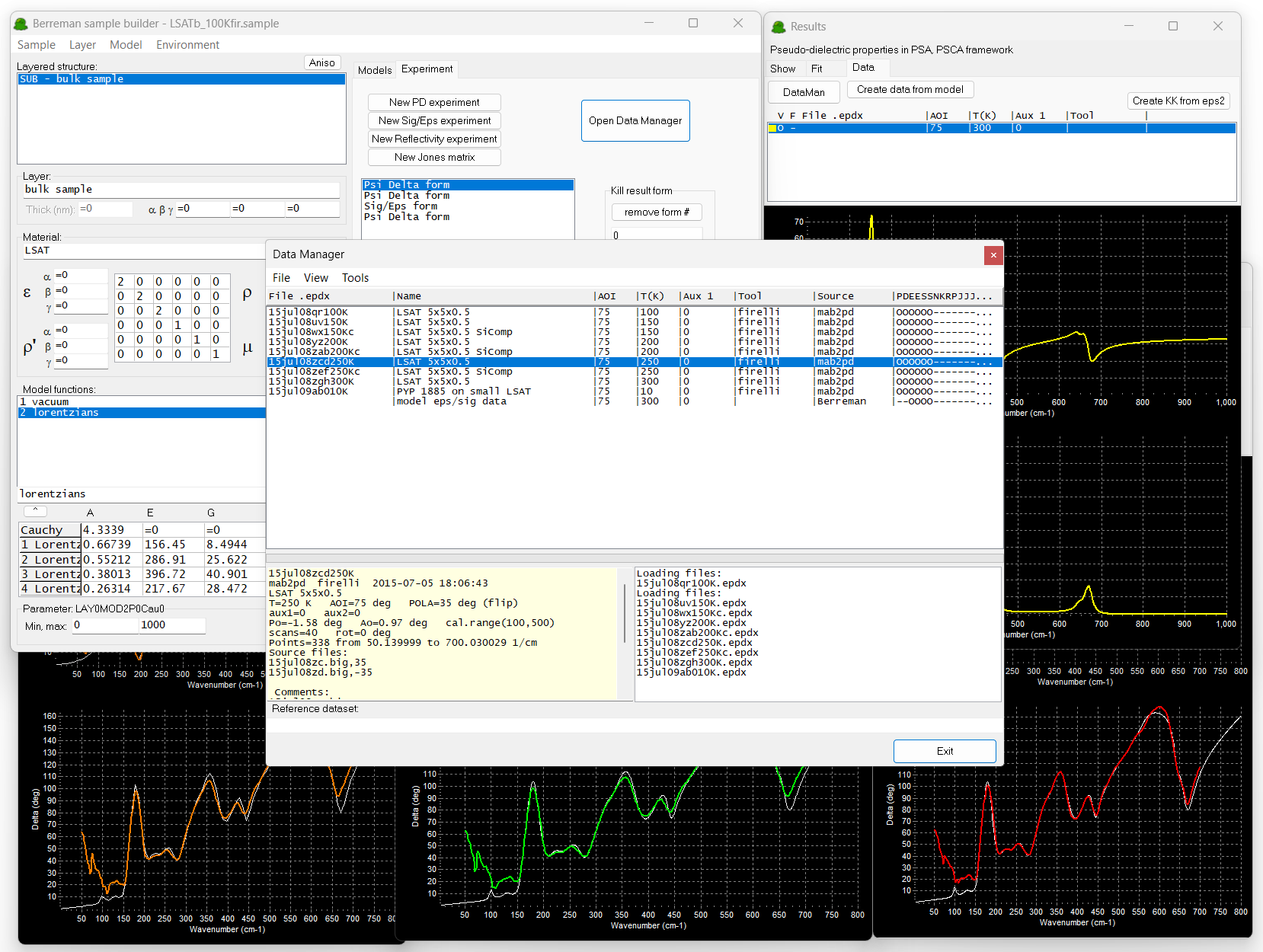
The lastest version of Berreman Sample Builder is 1.2.10.7 from november 2016, after that date, new software in the 2nd QBerr generation started to take shape.
QBerr 2
Year 2015 marks the start of large rewrite of the codebase from Pascal to Qt/C++. Qt framework and development environment was chosen for its cross platform support, good GUI design tools, but also due to the existence of excellent open source graph plotting component QCustomPlot. The name QBerr was coined to denote the Qt-written collection of libraries.
As a first step, the libraries supporting .epdx data standard were ported to C++ and generalized for storage of time-domain spectroscopy data in the .meax format.
Next step was completely new implementation of CalibRCE 2.0 - software for processing and calibration of rotating compensator data in the context of mid-infrared ellipsometry. First deployed in 2015, improved in 2017, and eventually served as a platform for future development of the 3rd generation. See version history.
Finally, a new version of QBerr SampleBuilder was being developed. DataMan was redesigned in 2016 to work as a standalone program, but also as a component of the SampleBuilder.
In 2019, mab2pd2, the RAE calibration program, was first ported to C++, then enhanced with new corrections for non-idealities of polarizers and detectors.
LabLISP project started in 2020 with new approaches to symbolic and asynchronous operation of software in LabApps context (TellMagSoft, IrElliSoft). That later triggered revisit of the QBerr code.
QBerr 3
First upgrades to QBerr 3 were done in 2022 on the basic DataSet libraries. Where QBerr 2 presented an attempt in designing for user comfort and safety, QBerr 3 is becoming more bare metal and refactored to be fast, but also more flexible.
First application that benefited from modern QBerr 3 was a completely new version of THzElli 2, control software for time-domain ellipsometer in 2023, with integration of DataMan 3 since the beginning of 2024.
Over 2024, DataMan became LabLISP scriptable as LabApps device. See related projects for more details.
And in 2025, 20 years after first versions, also mab2mm 3 and LookData 3 projects were initiated.
Latest progress is happening in the SampleBuilder 3 project, designed for tighter integration with LabApps and LabLISP, support for parallelization, and LabLISP scripting.